KL averages 27-33°C with 70-90% humidity. "Passive" sweating happens whether you exercise or not — your body is constantly working to cool itself. The standard "drink 8 glasses of water a day" advice was built around a temperate-climate baseline that doesn't account for what your body is actually losing in this kind of heat.
This guide is for people in Malaysia (or anywhere similarly tropical) who want to understand hydration as it actually works here, and decide for themselves whether daily electrolyte support makes sense. We'll be honest about who needs them, who doesn't, and how to think about it without falling for either the wellness-industry overselling or the medical-establishment under-selling.
We make a daily electrolyte product (ELT). We're going to be careful to keep this guide useful regardless of whether you ever buy from us.
How tropical climate changes the hydration equation
The single biggest variable in hydration is sweat volume — and sweat is determined by ambient temperature, humidity, and activity. Move any of those up, you sweat more.
A sedentary adult in 22°C, 50% humidity (a temperate office) loses about 1.5-2 liters of fluid per day through breathing, urination, and minimal sweating. That's the assumption behind "8 glasses of water."
A sedentary adult in 30°C, 80% humidity (an average KL outdoor afternoon) can lose 3-4+ liters per day even with zero exercise. The body sweats just to maintain core temperature, and humidity prevents that sweat from evaporating efficiently — so you sweat more to compensate. The result: you're losing more, you're cooling less efficiently, and the standard guidance dramatically underestimates your actual fluid needs.
Add a 60-minute outdoor walk in the afternoon and the loss climbs to 4-5L/day. Add a workout, a padel match, or a hike, and you're routinely at 5-7L/day.
The ambient sweat — the kind you don't really notice because you're not visibly dripping — is the part most people in tropical climates underestimate. You walk to the car, you walk into a 7-Eleven, you sit in a poorly-cooled meeting room. Each of those is costing you fluid and electrolytes you don't register losing.
The "I don't feel thirsty so I'm fine" trap
Thirst is a lagging indicator. By the time you feel actively thirsty, you've already lost about 1-2% of your body weight in fluid — enough to measurably affect cognitive performance and physical output. Studies in athletes and military personnel show measurable drops in concentration, reaction time, and coordination at this level of dehydration.
In tropical climates, this lag matters more because the cumulative loss happens faster. An adult in San Francisco might drink to thirst and stay roughly hydrated. An adult in KL drinking to thirst is often running a chronic mild deficit they don't notice as anything specific — just "I'm a bit tired, a bit slower, a bit foggier."
Air-conditioning compounds the problem
Air conditioning works by removing humidity from the air, which means the air it pumps out is dry. Breathing dry air for 8 hours a day in your office (and another 8 in your bedroom) costs you fluid through respiration alone — about 200-400ml extra per day on top of your sweat losses.
The combination is what makes tropical-climate hydration genuinely different from temperate-climate hydration: outdoor sweating + indoor dehumidification means you're losing fluid in both environments, all day.
What general medical advice gets wrong (and right) for Malaysia
When you Google "do I need electrolytes daily," you get a fairly consistent answer from authority sites like Mayo Clinic, Harvard, Cleveland Clinic, and the American Heart Association: for sedentary adults eating a balanced diet, plain water is enough. Electrolyte supplements are only necessary in cases of significant fluid loss (illness, intense exercise) or specific medical conditions.
That advice is correct for sedentary adults in temperate climates eating a balanced diet. It's also incomplete for people in tropical climates with sustained ambient sweating.
The mainstream medical position assumes:
- You're losing roughly 1-2L of fluid per day
- Your sweat losses are minimal at rest
- Your diet provides adequate sodium, potassium, and magnesium
- Your activity is moderate and indoor-biased
In KL, two of those four assumptions are usually wrong. You're losing more fluid (because of climate), and a lot of that loss is sweat (because of climate plus activity). Your diet may or may not be making up the difference depending on what you eat.
The honest synthesis: most people in Malaysia don't need daily electrolytes the way an ultra-marathoner does. But most people in Malaysia probably do lose more electrolytes daily than the global advice accounts for — and a small daily supplement closes the gap.
It's not a medical necessity for most. It's a quality-of-life optimization that has more evidence behind it in tropical climates than the global "you don't need them" advice acknowledges.
The four electrolytes that actually matter for daily hydration
Sodium (Na)
The big one. Sodium is the primary electrolyte your body loses through sweat. Daily sodium loss in sweat varies hugely by individual:
- Light sweater: 300-600mg per liter of sweat
- Average sweater: 600-1000mg per liter
- Heavy/salty sweater: 1000-1500mg per liter (white salt rings on your shirt)
If you're losing 2-3L of sweat per day in tropical climate (active outdoor adult), that's 1,500-3,000mg of sodium loss daily. The Malaysian diet generally provides ample sodium, so most people aren't deficient. But the replenishment timing matters — ideally you replace sodium close to when you lose it.
Potassium (K)
Potassium is the inside-the-cell counterpart to sodium. It plays a role in muscle contraction (low potassium = cramps), nerve signaling, and blood pressure regulation. Sweat losses are smaller than sodium (~150-200mg per liter), but cumulative across a day they add up.
Dietary potassium comes from fruits, vegetables, nuts, beans. Most Malaysian diets are adequate but not abundant — a banana is ~400mg, a cup of cooked spinach is ~840mg.
Magnesium (Mg)
Magnesium is the under-replaced electrolyte. It's involved in over 300 enzymatic reactions, plays a major role in sleep and muscle function, and is chronically under-consumed in modern diets. Studies suggest ~50-60% of adults in industrialized countries are below the RDA.
If you have trouble sleeping, get muscle cramps at night, or experience persistent low-grade fatigue, magnesium is one of the more evidence-supported electrolytes to add. A daily electrolyte sachet typically delivers 50-100mg.
Calcium (Ca)
Calcium is involved in muscle function and bone health, but daily intake from dairy, leafy greens, and (in MY) tofu/tempeh is usually adequate. Sweat losses are minimal. Most quality electrolyte products skip it because the daily-replacement case is weakest.
What you're losing and replacing
| Electrolyte | Daily loss (tropical, active) | Diet provides (MY) | Daily sachet adds |
|---|---|---|---|
| Sodium | 1,500-3,000mg | Often ample (3,000-4,000mg) | 200-1,000mg |
| Potassium | 300-500mg | Variable (1,500-3,500mg) | 100-400mg |
| Magnesium | 20-40mg | Often below RDA | 50-100mg |
| Calcium | <50mg | Adequate | Often 0 |
The takeaway: a daily electrolyte sachet doesn't replace what you lose. It complements what your diet provides and helps with the timing and the magnesium gap.
Signs of mild chronic dehydration most people miss
Severe dehydration is obvious — dizziness, dark urine, dry mouth, headaches. Mild chronic dehydration is harder to spot because the symptoms are vague enough to be blamed on other things.
Common patterns in tropical-climate adults:
- The 4pm crash — afternoon fatigue that coffee doesn't fix. Often blamed on poor sleep, work stress, or post-lunch insulin spike. Dehydration is one of the most common contributors and easiest to test for.
- Cramping at night — calf cramps, foot cramps, charley horses. Often a combination of low magnesium + low sodium + too-late hydration.
- Headaches that come and go — particularly in the late afternoon, particularly after a long meeting in aircon.
- Trouble focusing in mid-afternoon — measurable in lab studies at just 1-2% body weight fluid deficit.
- Dark or strong-smelling urine — the simplest test. Pale yellow = good. Dark amber = dehydrated.
- Constipation, despite eating fiber — your body pulls water from your colon when systemic hydration is low.
- That heavy, drained feeling after a long humid day — partly mineral depletion, partly fluid deficit.
The frustrating thing about all of these: each can be explained away by something else. Dehydration is rarely the only cause, but it's frequently a contributor and almost always the easiest to fix.
If you have two or more of these patterns chronically, a 7-day experiment is worth running: add a daily electrolyte mix to a morning glass of water, drink water consistently through the day, and notice what changes. If nothing changes, dehydration wasn't your bottleneck. If something does change, you've found a cheap quality-of-life lift.
How much water (and electrolytes) you actually need in Malaysia
Skip the "8 glasses" framing. A more useful starting point:
Baseline water intake (sedentary, indoor, aircon-heavy):
- 30-40ml per kg of body weight
- A 70kg adult: 2.1-2.8L of water per day
- This is just the floor — actual intake should be higher in tropical climates
Add for outdoor exposure:
- 500ml to 1L per hour of moderate outdoor exposure (walking, errands)
Add for training:
- 500ml-1.5L per hour of training in heat
- 300-700mg of sodium per hour of active sweating
A practical daily target for an active adult in KL:
- 3-4L total fluid intake (water + other beverages, mostly water)
- One daily electrolyte sachet (or equivalent from food + targeted supplementation)
- An additional sachet on heavy training or long-outdoor days
Should you take electrolytes daily? An honest decision framework
Not everyone benefits from a daily electrolyte sachet. Here's a rough sort:
Group 1 — Probably no daily need
- You work from home or an office, almost entirely indoor
- You drink water consistently through the day
- You eat home-cooked meals with vegetables
- You don't exercise more than 2-3 times a week, and not in heat
- You don't have any chronic mild-dehydration symptoms
Plain water + your normal diet probably has you covered. Save the money. Where it can still help: a sachet on an unusually hot day, after a heavy workout, or during illness.
Group 2 — Probably worth trying
- Hybrid work pattern with regular outdoor errands
- Gym 3-4 times a week, sometimes in heat
- Occasional afternoon fatigue or cramping
- Eats well most days but not consistently
- Wants more energy in the second half of the day
Run the 7-day experiment. Try a daily zero-sugar electrolyte sachet in the morning for a week. If you feel better, keep it. If you don't, drop it.
Group 3 — Likely daily benefit
- Outdoor work or extensive outdoor errand running
- Training 4+ times a week, especially in heat
- Breastfeeding parents (electrolyte needs change)
- Sweat-heavy occupations (delivery riders, construction, fieldwork)
- Persistent afternoon fatigue, cramping at night, or chronic mild headaches that hydration resolves
- Following keto, low-carb, or fasting protocols
Daily electrolytes are likely meaningful and the 7-day experiment will probably confirm it. The price of a sachet a day is low compared to the quality-of-life difference.
Building hydration into a daily routine
If you decide it's worth doing, the practical question becomes: when?
Morning (within 30 min of waking): A glass of water (300-500ml) + your daily electrolyte sachet, before coffee. This addresses overnight fluid loss and pre-loads the day.
Mid-morning to lunch: Sip water consistently — keep a 1L bottle on your desk, aim to finish it by 12:30. No electrolytes needed here for most people.
Pre-training or pre-outdoor (30 min before): 250-500ml water. If long or hot, a second electrolyte sachet here.
Post-training (within 30 min): 500ml water. Food (carbs + protein) for recovery.
Evening: Light sips with dinner. Avoid heavy fluid intake after 8pm.
Before bed (if you cramp at night): A glass of water + a magnesium-rich snack (banana, dark chocolate, almonds).
The most under-rated part of this routine is the morning electrolyte. It addresses the dehydration you've accumulated overnight before you've started the daytime losses. Most people skip it, drink coffee on a deficit, and spend the next two hours trying to catch up.
Start with the morning sachet
RM 64.80 per pouch · 12 sachets · 600mg sodium · zero sugar · stevia-sweetened · 10% off your first pack
Try ELTChoosing what to drink — a no-bullshit category guide
Plain water
Still the foundation, always. No replacement for water. The question is what to add to it occasionally. Filtered or boiled is the practical default in MY.
Coconut water
A real natural electrolyte drink — about 250mg sodium and 600mg potassium per 250ml, with naturally occurring sugars. Genuinely good for sport recovery, but the natural sugar load (~6-8g per cup) and the price-per-electrolyte make it less practical as a daily-format option.
100Plus Original / Pocari Sweat (regular)
Both are sugary isotonic drinks designed for sport. Both work fine occasionally. Neither is a great daily habit — see our 100Plus vs Pocari Sweat sugar comparison for the breakdown.
100Plus Zero / Pocari Sweat Ion Water
Better than the regular versions for daily use, but the sodium dose is light (~80-190mg per serving) and the artificial sweetener load adds up if it's your default drink.
Daily-format electrolyte powders
The category built for this use case. Single-serve sachets, mixed with water, designed to be drunk daily.
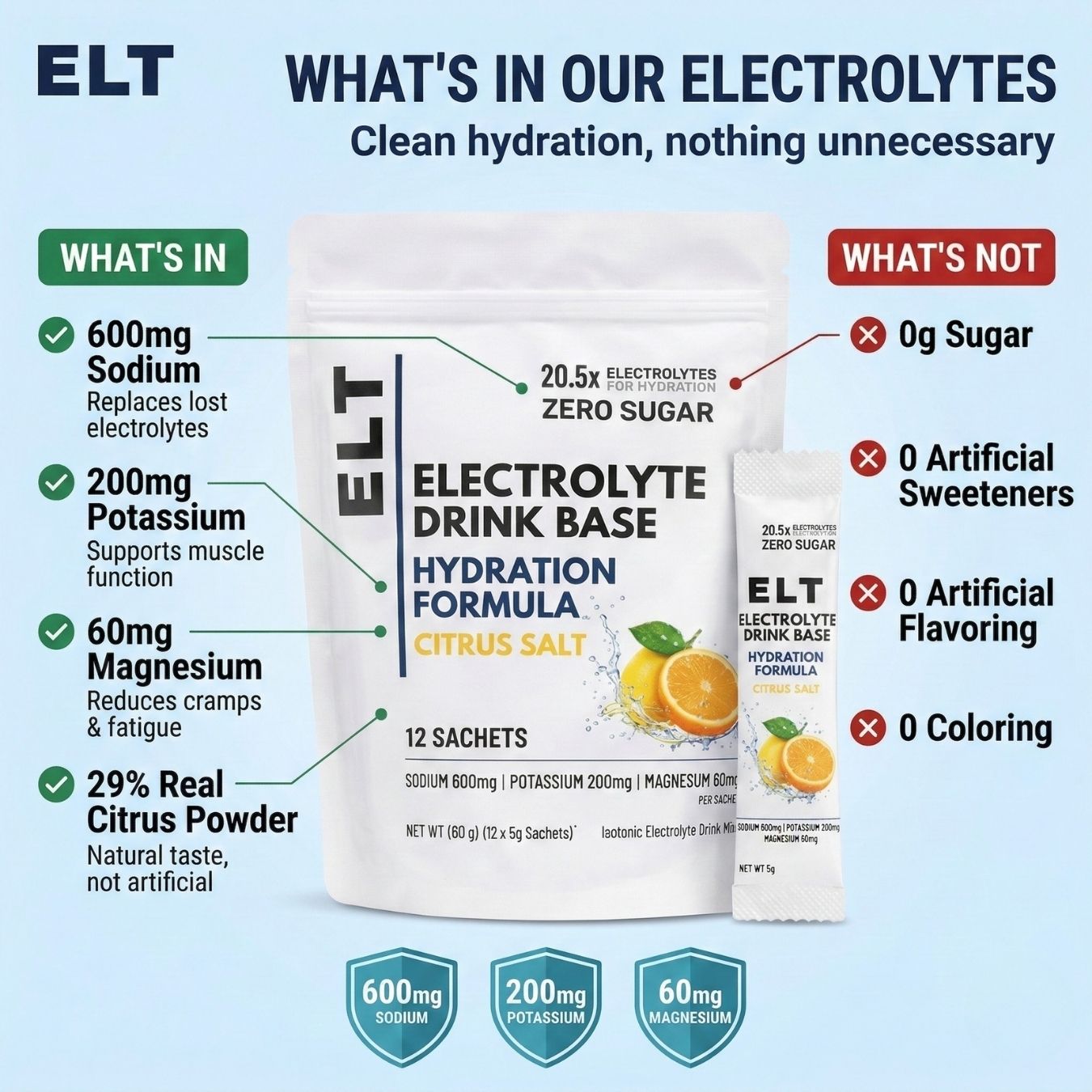
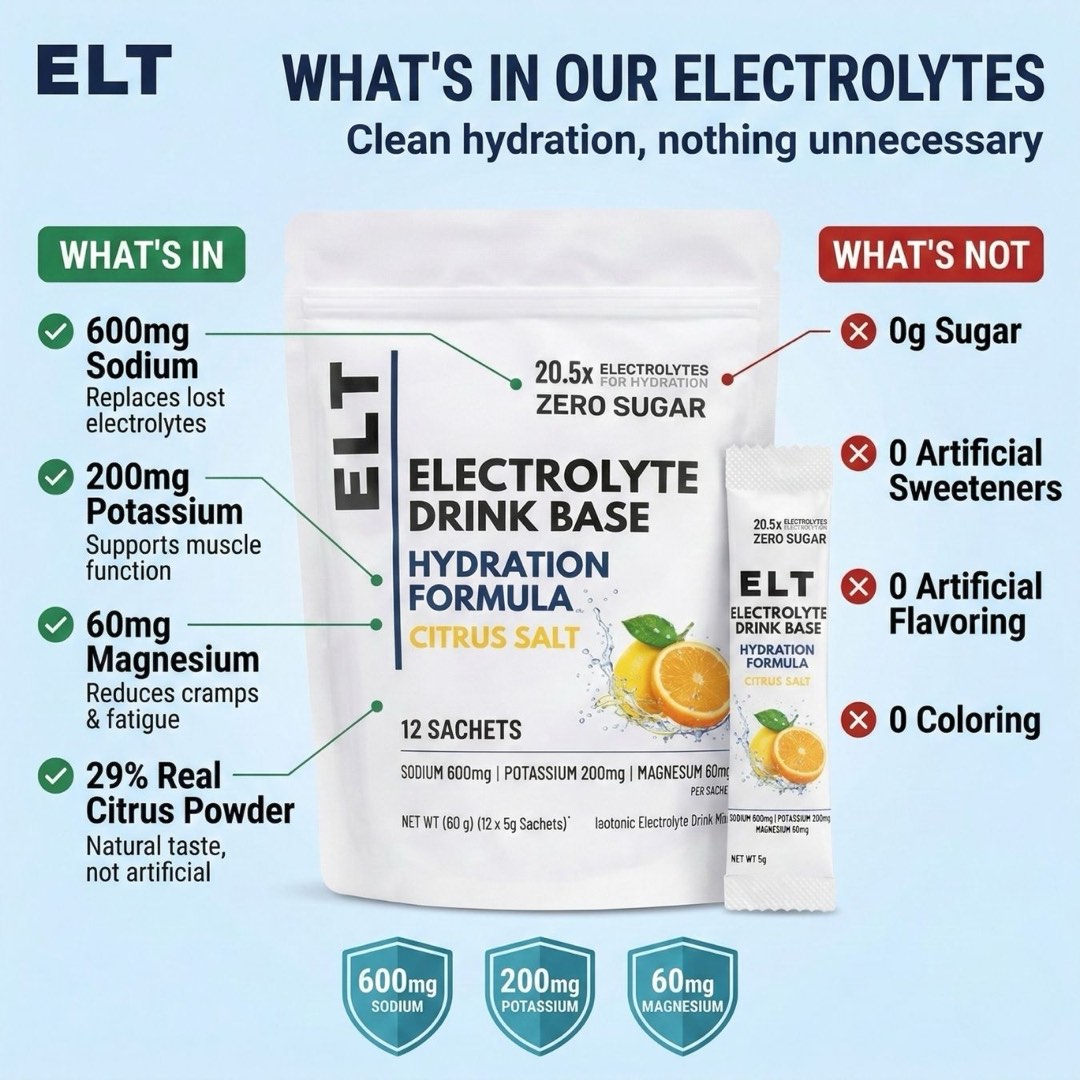
- ELT — what we make. 600mg sodium, 200mg potassium, 60mg magnesium, 0g sugar, stevia-sweetened, 29% real citrus powder. Halal-certified ingredients. RM 5.40 per sachet.
- Koda Nutrition — also Malaysia-made, sucralose-sweetened, 430mg sodium per stick.
- LMNT (imported) — 1,000mg sodium per stick, keto-coded. Higher sodium than most people need daily.
- Liquid I.V. (imported) — has 11g sugar per stick. See our Liquid IV alternative comparison.
For a deeper comparison, see our best zero-sugar electrolyte buyer's guide.
ORS (oral rehydration salts)
The medical-grade option. Available at any pharmacy in MY for RM 1-3 per sachet. Designed specifically for illness recovery and severe dehydration. Use it for sick days, hangovers, and post-food-poisoning — not as a daily drink.
Common myths about daily electrolytes
"Too much sodium will give you high blood pressure."
The relationship between sodium and blood pressure is real but more nuanced than "salt = bad." For most healthy adults, sodium intake within 2,000-3,500mg per day is fine. People with diagnosed hypertension or kidney conditions should follow their doctor's guidance.
"You only need electrolytes when you sweat heavily."
True for temperate-climate sedentary adults. Less true for tropical-climate adults with constant ambient sweating.
"Electrolyte drinks are basically Gatorade."
Sugar load is the entire difference. A 500ml Gatorade has 30g of sugar (similar to Pocari). A zero-sugar daily electrolyte powder has 0g.
"If you drink water, you're hydrated."
Volume of water is necessary but not sufficient. If you're losing significant electrolytes through sweat, drinking only plain water can dilute your blood sodium (rare but possible — hyponatremia). Mineral balance matters alongside fluid volume.
When to talk to a doctor
A daily electrolyte sachet is generally safe for healthy adults. Cases where you should check first:
- Pregnancy or breastfeeding — electrolyte needs change
- Kidney disease or reduced kidney function — sodium load matters more
- Blood pressure on medication — particularly diuretics or sodium-restricted protocols
- Heart conditions — fluid balance is more sensitive
- Diabetes — sugar-free is fine, but always check the full ingredient list
- Persistent symptoms (headaches, dizziness, severe fatigue) that don't resolve with hydration — these need a real diagnosis
Frequently asked questions
Do I need electrolytes daily in Malaysia?
It depends. For sedentary adults in air-conditioned environments who eat a balanced diet, plain water is probably enough. For active adults, outdoor workers, or anyone with chronic afternoon fatigue or cramping, a daily zero-sugar electrolyte sachet is a low-cost experiment that often delivers a quality-of-life lift. Try it for 7 days and see what changes.
Can I take electrolytes every day safely?
For most healthy adults, yes. Sodium and potassium are essential nutrients you replace daily through food and fluid anyway. Magnesium at typical electrolyte-drink doses (50-100mg) is well within safe levels. Talk to a doctor first if you have kidney disease, blood pressure on medication, heart conditions, or are pregnant.
How much water should I drink in KL?
A practical floor: 30-40ml per kg of body weight (so a 70kg adult should drink at least 2.1-2.8L). Add 500ml-1L per hour of outdoor exposure, and 500ml-1.5L per hour of training in heat. Most active adults in KL do well at 3-4L/day total fluid. The simplest test: pale yellow urine throughout the day.
Is daily electrolyte powder better than 100Plus or Pocari Sweat?
For daily use, yes. 100Plus and Pocari are designed for sport — they include sugar that makes sense during heavy sweating but is unnecessary daily. A zero-sugar daily-format powder gives you comparable or better electrolyte content (especially sodium) without the sugar load.
What's the cheapest way to stay hydrated in tropical climate?
Plain filtered water is the cheapest hydration. If you want electrolyte support, ORS sachets from a Malaysian pharmacy are the cheapest option (RM 1-3 per sachet), though designed for illness recovery rather than daily use. Daily-format zero-sugar powders run RM 4-6 per serving for products like ELT or Koda. Imported brands like LMNT and Liquid IV run RM 7-14 per serving.
Are there risks to taking electrolytes every day?
For healthy adults at typical doses, the risks are minimal. The main concerns are: excessive sodium intake if you have hypertension or kidney issues, gastrointestinal discomfort if you're sensitive to certain sweeteners, and rare cases of mineral imbalance from very high doses. A standard daily sachet (200-1,000mg sodium) consumed alongside a normal diet doesn't pose meaningful risk for most people.
Closing
Hydration is the keystone habit. It's the simplest health intervention with the highest payoff: pay attention to what your body's losing and replace it. Get this right and the rest of your health stack starts to work. Sleep is better. Training is better. Focus is better.
In a tropical climate, the gap between "good enough" and "actually well-hydrated" is wider than the global advice acknowledges. Most adults in KL are living with a low-grade chronic deficit they don't notice as anything specific. Closing that gap costs about RM 5 a day and a minute of effort in the morning.
ELT is what we built for the daily version of this — 600mg sodium, 200mg potassium, 60mg magnesium per sachet, zero sugar, stevia-sweetened, halal-certified ingredients, ships from PJ. RM 64.80 for 12 sachets. The first pack is 10% off.
But the bigger point isn't the brand. It's the habit. Start with the morning glass of water. Pay attention to what changes. Build from there.
We've got you.