A single 500ml bottle of Pocari Sweat contains about 30 grams of sugar — roughly seven teaspoons. The WHO daily added-sugar limit for adults is 25g. You exceed your daily sugar allowance before the bottle is empty.
A 325ml can of 100Plus Original contains about 21 grams of sugar — roughly five teaspoons. Smaller bottle, slightly less sugar, but still a meaningful chunk of your day's sugar budget gone in one drink.
This piece is for the person who's been reaching for one of these for years and starting to wonder whether it's actually doing what they think it's doing. The short version: both are fine occasionally. Neither is a great daily habit. There are better options if hydration — not flavor — is what you actually want.
Sugar content side by side
These are the SKUs you'll find in any KL/PJ kedai runcit, 7-Eleven, or Watsons fridge.
| Product | Serving | Sugar | Teaspoons | % of WHO daily limit |
|---|---|---|---|---|
| Pocari Sweat (regular) | 500ml | ~30g | ~7 | 120% (over limit) |
| Pocari Sweat Ion Water | 500ml | ~15g | ~3.5 | 60% |
| 100Plus Original | 325ml | ~21g | ~5 | 84% |
| 100Plus Reduced Sugar | 325ml | ~13g | ~3 | 52% |
| 100Plus Zero | 325ml | 0g | 0 | 0% (sucralose + acesulfame-K) |
The thing that surprises most people: the regular versions of both drinks blow past your daily sugar allowance in a single bottle. That's not because Pocari and 100Plus are uniquely sugary — it's because the WHO daily limit is genuinely small (25g), and most processed drinks ignore it.
For context: a can of Coca-Cola (320ml) has about 35g of sugar. A 500ml Pocari is in roughly the same league.
Electrolyte content compared
Sugar is the headline. But the other reason people drink these is electrolytes. Here's how they actually stack up:
| Product | Sodium | Potassium | Magnesium |
|---|---|---|---|
| Pocari Sweat 500ml | ~245mg | ~110mg | not listed |
| Pocari Sweat Ion Water 500ml | ~190mg | ~95mg | not listed |
| 100Plus Original 325ml | ~80mg | ~20mg | not listed |
| 100Plus Reduced Sugar 325ml | ~80mg | ~20mg | not listed |
| 100Plus Zero 325ml | ~80mg | ~20mg | not listed |
What jumps out:
- Pocari Sweat is genuinely a real isotonic — sodium is in a useful range for actual sweat replacement, especially the regular formula.
- 100Plus is much lighter on electrolytes than its branding suggests. 80mg of sodium per can is a sip, not a serious replenishment dose. The Reduced Sugar and Zero versions don't change electrolyte content — they just change the sugar.
- Neither lists magnesium. Either not added or below labeling threshold.
The verdict on electrolytes alone: Pocari Sweat is doing more for you than 100Plus on a sweat-replacement basis. But you're paying for that sodium with the sugar load in the regular formula.
When 100Plus or Pocari Sweat is genuinely fine
We're not anti-100Plus. It's a Malaysian institution. Pocari Sweat has been a SEA hydration staple for 40+ years. Both have legitimate uses:
- You played 90 minutes of futsal in the heat and sweated through your shirt — both work for fast carb + electrolyte replacement. Sugar at this moment is fuel, not waste.
- You're recovering from gastroenteritis or food poisoning — Pocari Sweat in particular is a common doctor recommendation in Asia for mild cases.
- You're a teenager with high energy needs and a 90-minute basketball practice — the carb + electrolyte combo is genuinely useful here.
- One bottle, occasionally, on a hot day — fine. Total sugar load over a week is what matters, not a single bottle.
The point isn't that these drinks are bad. It's that they're occasional drinks being used as daily drinks by a lot of people who'd be better off with water plus a zero-sugar electrolyte mix.
When 100Plus and Pocari Sweat work against you
A short list of moments where the regular versions are doing more harm than good:
- Daily desk job, sedentary, in air-conditioning — you're not losing the sodium they're delivering and you're banking the sugar as fat or driving insulin spikes.
- Trying to manage weight, blood sugar, or sugar cravings — a 500ml Pocari has more sugar than two scoops of ice cream.
- Drinking it as "healthier than soda" — it isn't. Same sugar tier as Sprite. The "isotonic" label doesn't change the load.
- Giving it to children daily — sugar adds up fast in a small body. Once-in-a-while at school sports is fine; daily after school is a habit worth questioning.
- Hangover recovery — sugar gives a brief lift but spikes and crashes. Plain water + an electrolyte powder or pharmacy ORS is more effective.
Pocari Sweat Ion Water and 100Plus Reduced Sugar — the middle option
Both brands have lower-sugar SKUs. Worth knowing:
Pocari Sweat Ion Water halves the sugar (~15g per 500ml vs ~30g) and uses sucralose to maintain flavor. The electrolyte profile drops slightly. A real improvement over the original, and a reasonable choice if you genuinely like the Pocari taste and use it regularly.
100Plus Reduced Sugar drops to about 13g per 325ml (down from 21g) — a 33% reduction with no artificial sweeteners. Actually the cleanest of the 100Plus range if you want to keep some sugar but cut the load.
100Plus Zero removes sugar entirely, replacing it with acesulfame-K and sucralose. Electrolyte content unchanged from regular 100Plus — still light. Good for the "I want a fizzy drink that isn't sugar-water" moment, but not a real electrolyte replenishment if you've been sweating heavily.
Want zero sugar AND real electrolyte content?
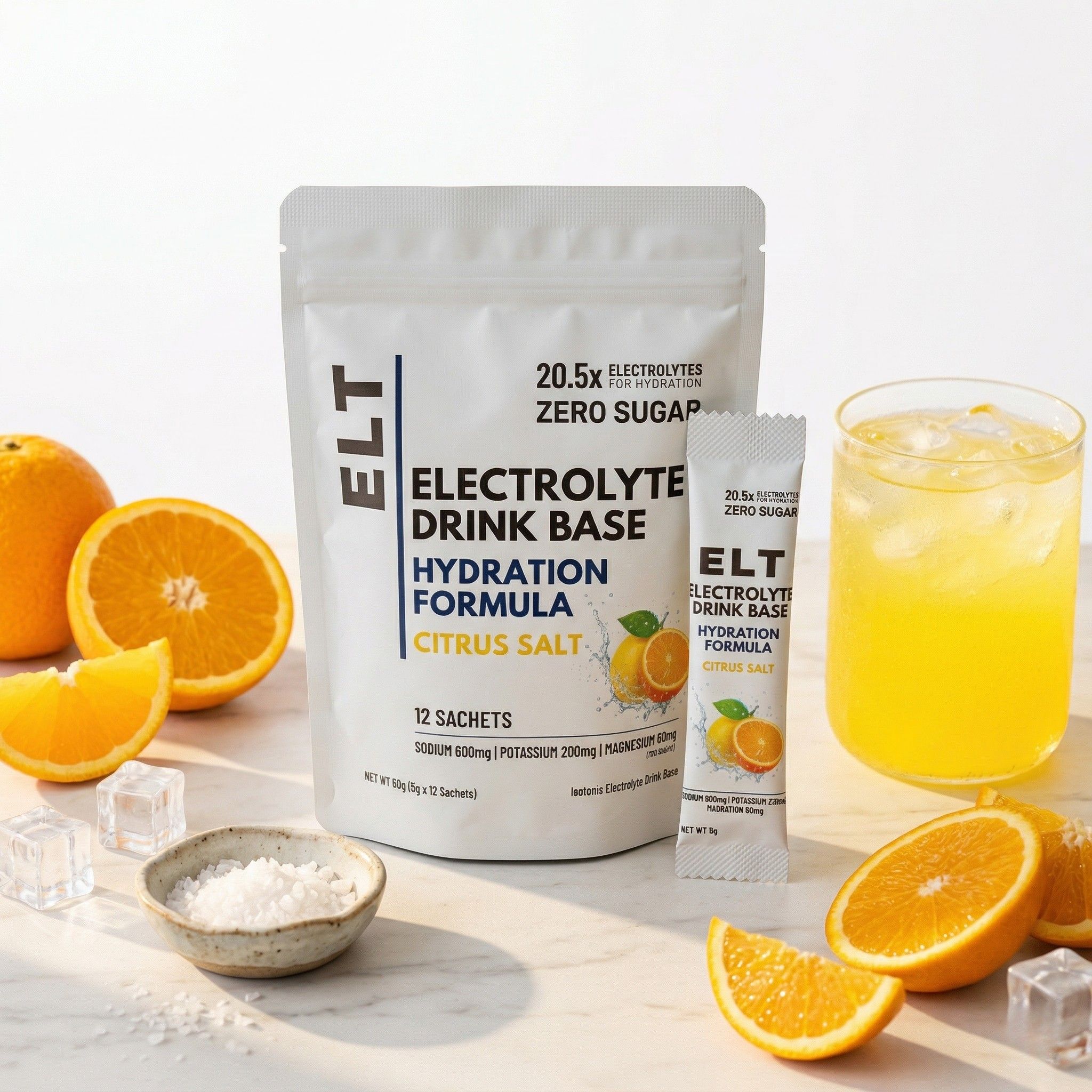
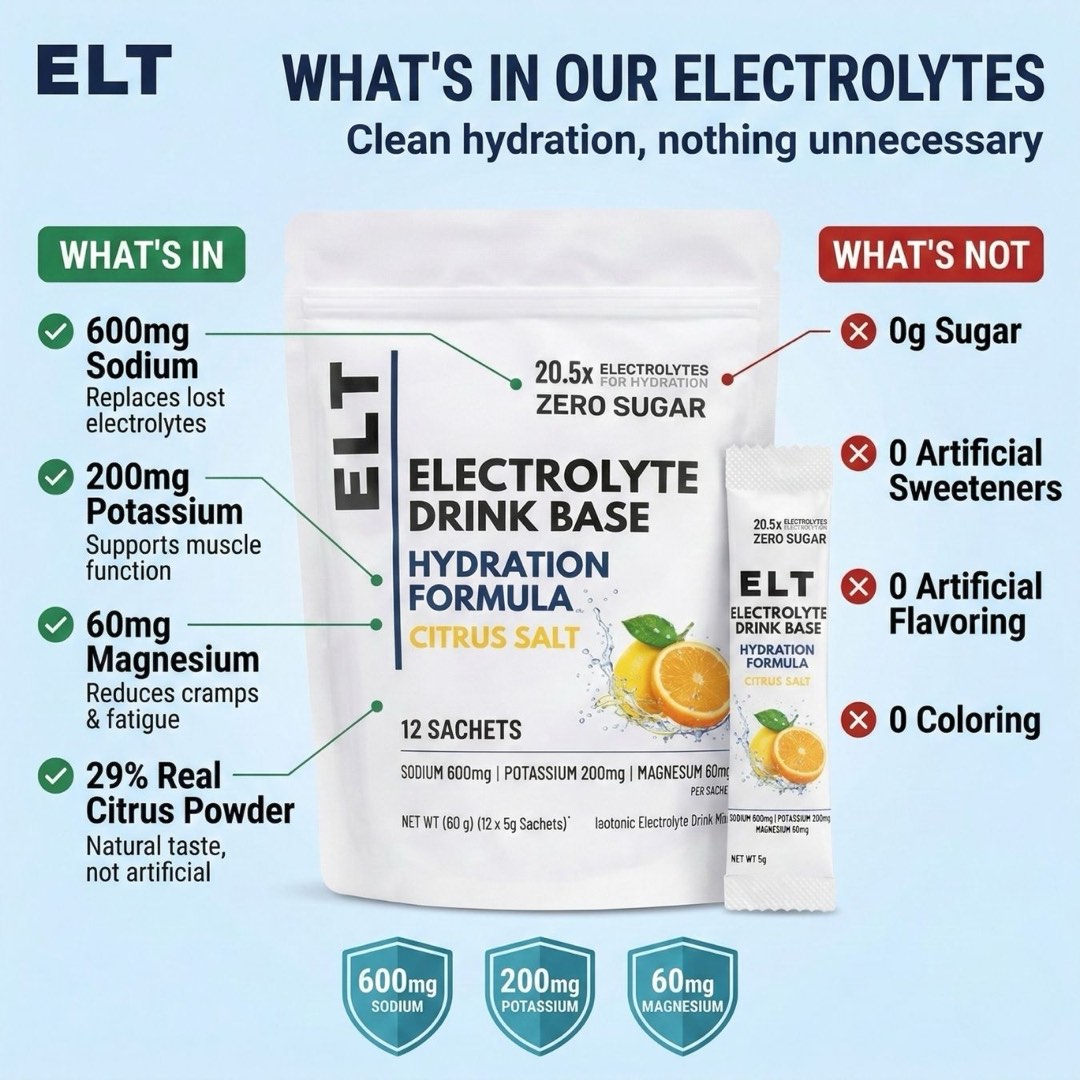
ELT is RM 64.80 for 12 sachets · 600mg sodium · 200mg potassium · 60mg magnesium · 0g sugar · stevia-sweetened · halal-certified ingredients
Try ELTWhat to drink instead — a simple decision tree
For each common situation, the cleaner answer:
For a one-off sport day or sweat-heavy event:
- Pocari Sweat Ion Water or 100Plus Zero work fine
- Or any zero-sugar daily-format powder mixed with water (more flexible)
For daily hydration in KL heat:
- Plain water is the foundation, always
- Add a zero-sugar electrolyte powder once a day for the heat-and-humidity offset
- ELT is what we make. Other options: Koda Nutrition, imported LMNT or DripDrop
- Skip the carbonated isotonics as a daily habit
For kids or family fridge:
- Default: filtered water with meals
- For active kids on hot days: half a sachet of a daily electrolyte powder (less salty), or diluted coconut water
- Avoid making sugary isotonics the daily fridge drink
For hangovers or food-poisoning recovery:
- ORS (oral rehydration salts) from any pharmacy — RM 1-3 per sachet, formulated specifically for this
- Plain water + small frequent sips
- A daily electrolyte powder works as a backup
For after a hard 1-hour padel match:
- Water + a zero-sugar electrolyte mix is enough for most players
- If it's a tournament day or 3+ hours, a higher-sodium product (LMNT-style or sport tab) covers the bigger losses. See our padel hydration guide.
Frequently asked questions
How much sugar is in a 500ml Pocari Sweat?
About 30 grams — roughly seven teaspoons. That exceeds the WHO daily added-sugar limit of 25g for an average adult.
How much sugar is in a can of 100Plus?
A 325ml can of 100Plus Original contains about 21 grams — roughly five teaspoons. The Reduced Sugar version drops to about 13g per can. 100Plus Zero contains 0g (sweetened with acesulfame-K and sucralose).
Is 100Plus Zero actually healthy?
It's fine, used as a sometimes-drink. Both sweeteners (acesulfame-K and sucralose) are approved as safe by the FDA, EFSA, and WHO. It contains no sugar. The sodium dose is light (~80mg per can), so it functions as a hydration sip rather than a meaningful electrolyte replenishment. The thing to be careful of is making it your every-day, all-day drink — partly because of the constant carbonation, partly because if you actually need electrolytes, a daily-format powder will do more for you with less.
Is Pocari Sweat OK for kids?
In moderation, yes — the formula is widely used in Asia for child hydration, especially during illness recovery. The concern is the sugar load if it becomes a daily drink. Pediatric guidelines from Malaysia's Health Ministry (and the WHO) caution against routine sugary drink consumption in children. The Ion Water version (lower sugar) is a better daily option. For sick days specifically, ORS from a pharmacy is the medically preferred answer.
What's the lowest-sugar isotonic in Malaysia?
Among the carbonated/RTD isotonics: 100Plus Zero at 0g sugar. Among the non-carbonated: Pocari Sweat Ion Water at ~15g per 500ml. If you broaden "isotonic" to include zero-sugar electrolyte powders mixed with water, ELT (0g), Koda Nutrition (0g), and imported LMNT (0g) all dominate on sugar-free hydration with substantially more electrolyte content per serving. See our full buyer's guide.
Are artificial sweeteners safer than sugar?
The official position from the FDA, EFSA, and WHO is that approved artificial sweeteners (sucralose, acesulfame-K, aspartame) are safe at typical intake levels. Some users report mild bloating or digestive discomfort with daily long-term use of artificial sweeteners, and there's a growing body of conversation (and some early research) about effects on gut bacteria. The practical takeaway: occasional use of artificial sweeteners is fine for most adults. If you'll drink something every single day, stevia (plant-derived) has fewer open questions than artificial sweeteners — which is one reason a growing share of Asian consumers prefer it.
So which one do you buy
- Want a real isotonic for actual sweat replacement, willing to accept the sugar? Pocari Sweat regular is the more honest sport-replacement drink of the two. Use it occasionally, on actual sweat days.
- Want zero sugar but still want the convenience of a can from the fridge? 100Plus Zero. Don't expect it to do much beyond rinse-hydration.
- Want to cut sugar but keep some flavor and brand familiarity? 100Plus Reduced Sugar (no artificial sweetener) or Pocari Ion Water (artificial sweetener, lower sugar).
- Want actual daily electrolyte support without the sugar load? A zero-sugar daily-format powder. ELT is what we make.
Most people, most days, the answer is the daily-format powder. Use Pocari or 100Plus when the moment specifically calls for it — a hot match, a hangover, an illness recovery. Don't make either your default.
If you want to try the daily version, the first pack is 10% off.
We've got you.