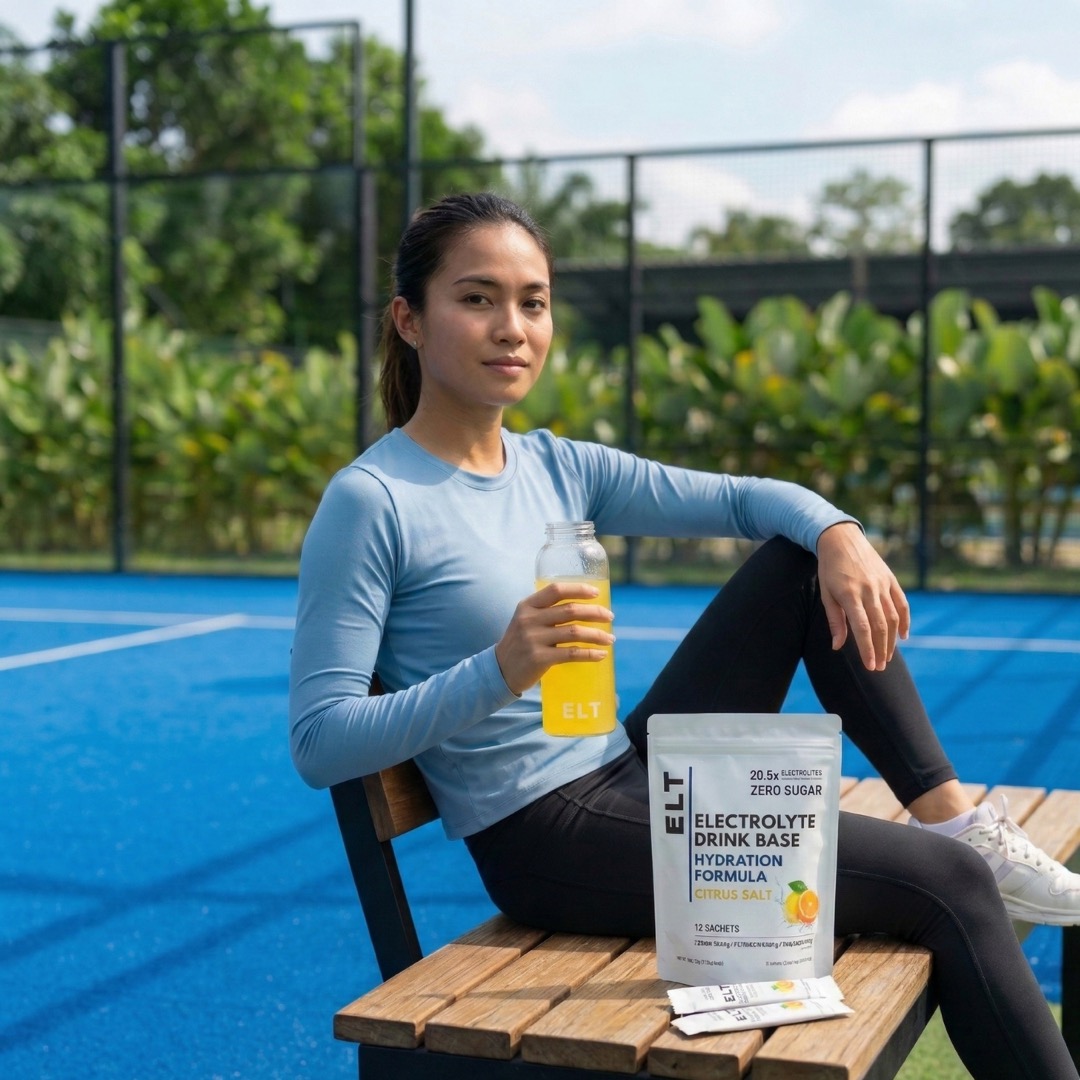
It's 4pm in KL. You've been working since 8. The aircon's been on so long your skin feels papery, but you've been outside twice and walked back drenched both times. You feel a low, dull tiredness that coffee isn't fixing, and your calf is starting to feel a little tight.
You go to grab something to drink, and you're standing in front of a fridge or a shelf or a phone with about a dozen options claiming to fix all of this. Best zero sugar electrolyte Malaysia brings up everything from carbonated cans at Watsons to imported powders on Lazada — with no editorial guide that actually compares them honestly. So we made one.
Most of what's marketed as zero-sugar electrolyte in Malaysia falls into one of three categories — and they're not interchangeable. The carbonated isotonic in a can does one job. The sport tab you drop into water does another. The daily-format powder in a sachet does a third. Picking right is mostly about knowing which job you're trying to do.
We make one of these products — ELT, a daily-format zero-sugar electrolyte built for the Malaysian climate. We're going to be honest about where ELT fits on this list and where it doesn't. The goal here is to help you actually buy the right thing for your day, not bend every recommendation toward us.
How to actually compare zero-sugar electrolytes
Three things matter. The rest is noise.
1. Sodium content per serving. This is the big one. Sodium is what your body loses most through sweat, and most products marketed as "electrolyte" underdose it. A serving with 100–300mg of sodium is a hydration rinse. A serving with 500–1000mg is hydration replacement. Both are useful, but for different moments. Reach for one when the other doesn't suit, and you'll feel the gap.
2. Sweetener type. "Zero sugar" can mean three different things, and the difference matters more than people assume. Stevia is plant-derived — extracted from the leaves of the stevia plant, used as a sweetener in South America for centuries. Sucralose and acesulfame-K are artificial sweeteners, both approved as safe by regulators worldwide and used in everything from diet sodas to protein bars.
All three are considered safe at typical intake levels. That said, some drinkers report bloating or mild digestive discomfort with artificial sweeteners on daily long-term use, and there's a growing body of conversation (and some early research) about effects on gut bacteria. Whether that turns out to be load-bearing science or just noise, a clear pattern is emerging in Asia: more people are actively choosing plant-derived sweeteners over artificial ones, especially for products they drink every single day. If you're someone who reads ingredient labels carefully — or just prefers things that come from a leaf rather than a lab — that preference matters when you're picking what to drink daily.
3. Daily-use suitability. Some products are formulated for sport-day use only — too much sodium, too aggressive a flavour, not pleasant to drink three times in a row. Others are formulated to drink every day for a year. If your goal is to build hydration into your routine, the format matters as much as the ingredients.
Two things that matter less than people think:
- Magnesium content. It's helpful, but daily magnesium needs are mostly met from food. 50–100mg in your hydration drink is a nice-to-have, not load-bearing.
- Brand origin. A US brand isn't automatically better than a Malaysian one. The question is what's in the sachet, not where it shipped from.
The three types of zero-sugar electrolyte you'll find in Malaysia
Type 1 — Carbonated isotonic drinks (ready-to-drink)
These come in cans and bottles. You buy them at 7-Eleven, Watsons, or the petrol station fridge. 100Plus Zero is the dominant local product. Pocari Sweat Ion Water is the Japanese counterpart with reduced sugar.
What they're for: convenience. You're already at the counter. You forgot a water bottle. You want something cold that isn't sugar-water.
What they're not for: daily use as your hydration foundation. The sodium is light (good for casual sip-on, not great for actual replacement), and you're paying a premium per ml for the can.
Type 2 — Sport-only electrolyte tabs and capsules
These are designed for active hydration during long sessions — running an event, cycling 60+ km, hiking under the sun. High5 Zero, Hammer Endurolytes Fizz, and Nuun all live in this category. Sold by Hobbies Sports, Hammer Nutrition Malaysia, and a handful of specialty stores.
What they're for: you're moving, you're sweating heavily, you need to top up between bottles. The format is usually a fizzing tablet you drop into 500–750ml of water.
A trade-off worth knowing before you buy: tabs and capsules take time to dissolve. Most need 1–3 minutes of fizzing in water before they're fully mixed, and longer if the water's cold or you're in a hurry. Compare that to a powder sachet, which dissolves in seconds with a quick stir. Per-serving electrolyte content also tends to be lower than daily-format powders — most sport tabs deliver 200–250mg of sodium per tablet, where daily-format powders deliver 400–600mg+. You'd need 2–3 tabs to match a single sachet, which adds up over a training week.
What they're not for: every day at your desk. The flavour is engineered to be palatable mid-effort, which often means it's a bit assertive when you're sitting still in an office chair.
Type 3 — Daily-format electrolyte powders
This is the newer category in Malaysia and the one growing fastest globally. Single-serve sachets. Powder, not tablet. Designed to be drunk daily — at breakfast, before training, in the afternoon, with food.
- ELT — made for Malaysia, Singapore, and the Southeast Asian region, citrus-salt flavour, what we make.
- LMNT, DripDrop, Liquid I.V. — imports, available via Lazada, Ubuy, and parallel-import sellers.
What they're for: building hydration into your daily routine. The minerals are tuned for living-and-sweating, not racing-and-sweating.
What they're not for: a one-off "I have a hangover" rescue. They'll work, but oral rehydration salts (ORS) from the pharmacy are cheaper for that single use case.
Side-by-side comparison
A quick look at how the most accessible zero-sugar options stack up. Numbers are per serving as listed by the manufacturer in mid-2026; flavours and formulations change, so check the current label before you buy.
| Product | Sodium | Potassium | Magnesium | Sugar | Sweetener | Format | Where to buy |
|---|---|---|---|---|---|---|---|
| ELT (Citrus Salt) | 600mg | 200mg | 60mg | 0g | Stevia | Powder sachet | drinkelt.com, Shopee |
| 100Plus Zero (325ml) | ~80mg | ~20mg | — | 0g | Acesulfame-K + Sucralose | Carbonated can | Watsons, 7-Eleven |
| High5 Zero | ~250mg | ~125mg | small | 0g | Sucralose | Effervescent tablet | Hobbies Sports MY |
| Hammer Endurolytes Fizz | ~200mg | ~100mg | ~50mg | 0g | Stevia | Effervescent tablet | Hammer Nutrition MY |
| LMNT (Citrus Salt) | 1000mg | 200mg | 60mg | 0g | Stevia | Powder stick | Shopee, Ubuy (imported) |
Two things jump out:
100Plus Zero is doing a lighter job than people assume. It's cheap, it's convenient, but the sodium is sip-replacement, not real replenishment. Drink it for the moment, not the day.
LMNT is the high-sodium outlier. That's its whole identity ("Stay Salty"). Built for keto, paleo, and heavy-sweat athletes. For most people, more sodium per serving than they actually need.
Best for daily hydration: ELT
We're going to keep this short and resist the temptation to oversell.
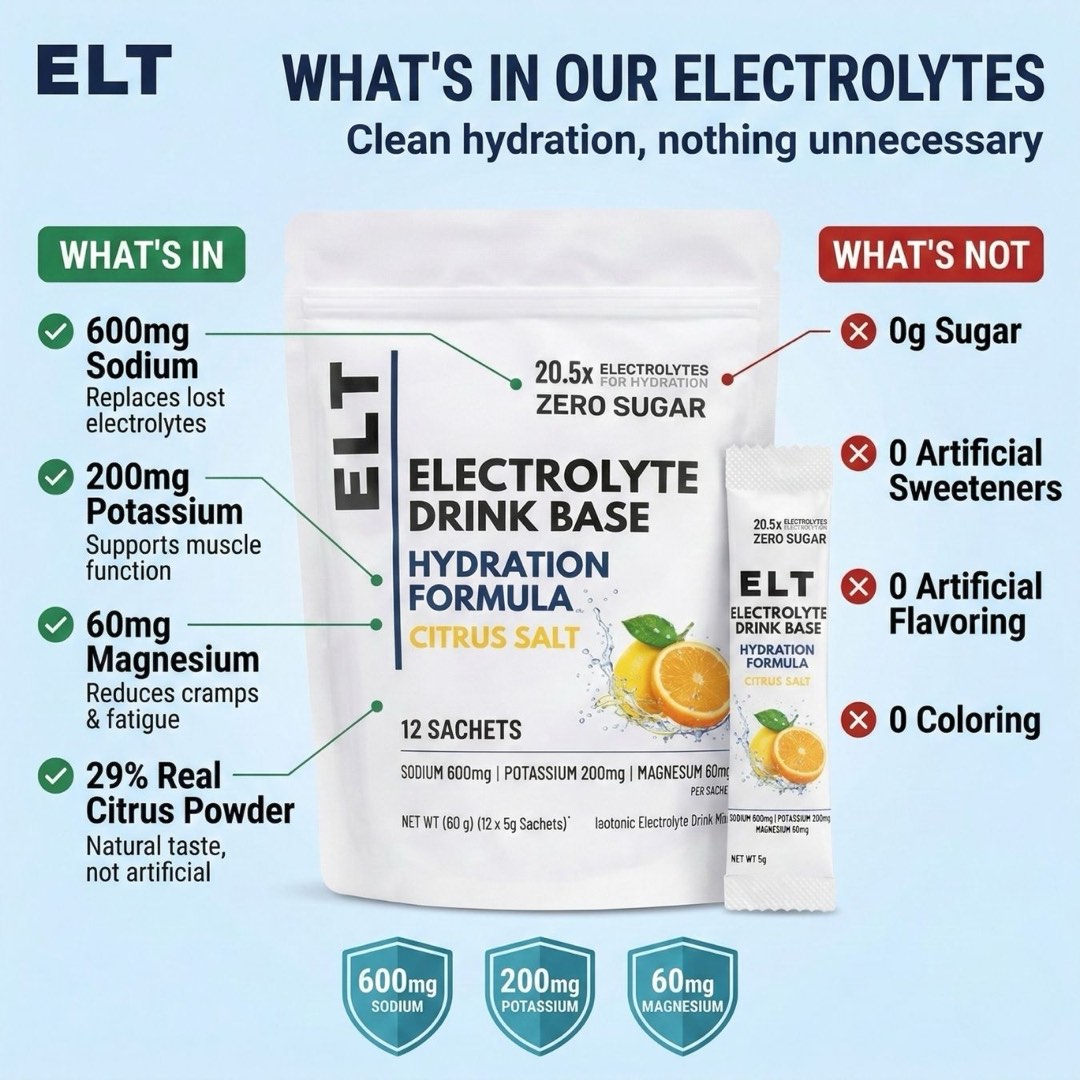
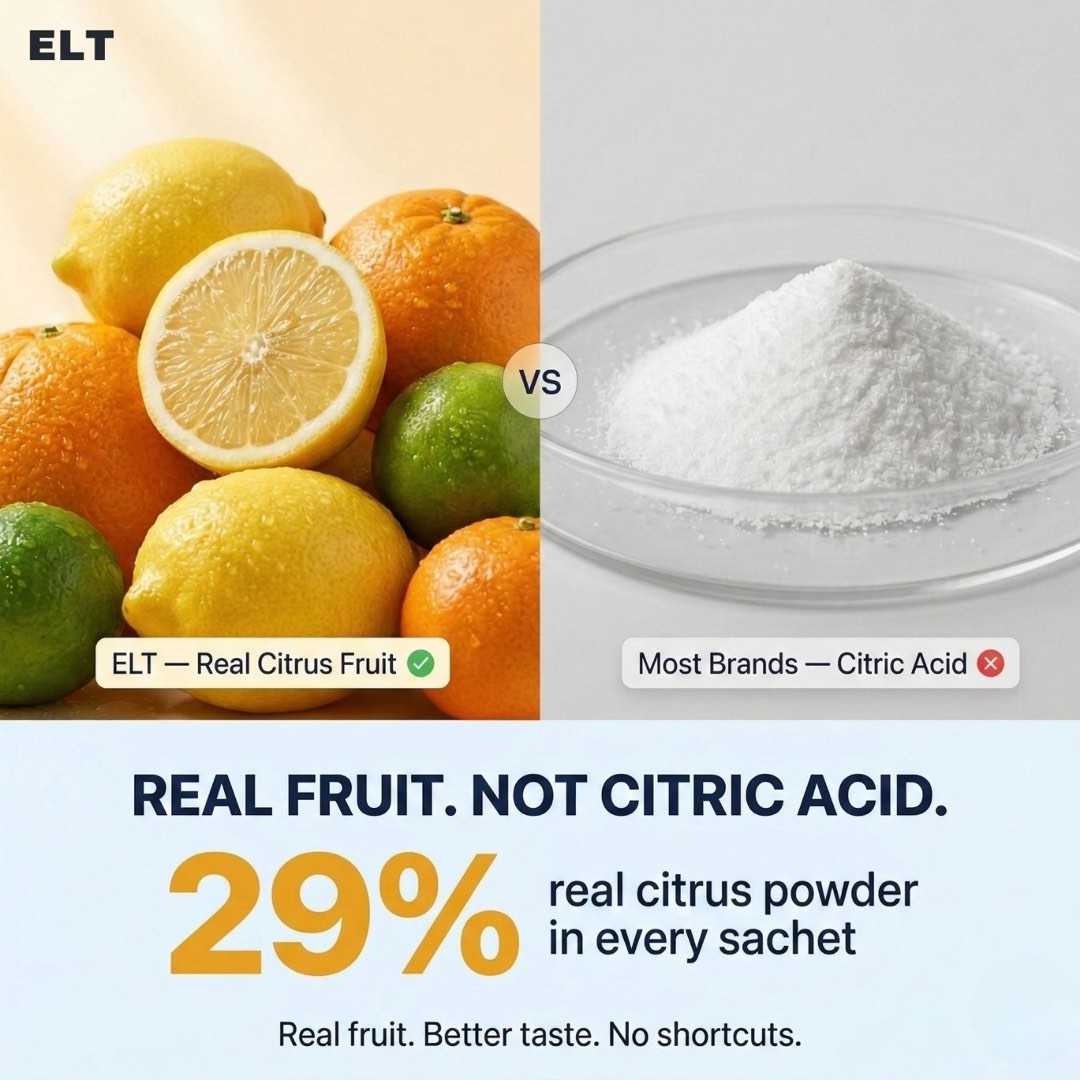
ELT is what we built to drink every day in Malaysia's heat without thinking too hard about it. 600mg sodium, 200mg potassium, 60mg magnesium per sachet — that's roughly 7× the total electrolyte content of a 325ml can of 100Plus Zero, in a format that actually fits a daily routine. The flavour comes from 29% real citrus powder — actual fruit, not "natural flavours" — and we sweeten it with stevia, plant-derived rather than lab-made. That's a deliberate choice: a meaningful share of our drinkers in Malaysia tell us they specifically want to avoid daily artificial sweeteners. Halal-certified ingredients. Vegan. We ship from a warehouse near KL — not from California — so it arrives in days, not weeks.
The sodium dose is in the middle of the category — more than 100Plus Zero, well below LMNT. We landed there because most of the people we built this for aren't doing 4-hour rides. They're doing real days: school run, work, kids, the 7pm padel game, dinner. Hydration that fits the day without dominating it.
What ELT is good for:
- Drinking every day, indefinitely
- Mornings before coffee
- Before, during, or after a workout
- Long outdoor afternoons in KL heat
- The 4pm slump, when you want something with taste but not a sugar crash
What ELT isn't ideal for:
- A one-off hangover rescue — try ORS from the pharmacy first (cheaper, formulated for this use)
- An ultra-marathon — you'll need more sodium per hour; pair with something like LMNT or sport-specific gels
- People who actively dislike stevia — some people taste it as bitter, and that's a real preference, not a flaw
A pouch is RM 64.80 for 12 sachets (RM 5.40 per serving). Subscriptions and bundles drop the per-serving price. There's a 10% off code on the first pack if you're new.
Try ELT for 12 days
RM 64.80 per pouch · 12 single-serve sachets · 10% off your first pack · Free shipping over RM 100 in West Malaysia
Shop ELTBest for grab-and-go (carbonated, ready-to-drink): 100Plus Zero
100Plus Zero exists for a reason. The Malaysian fridge ecosystem is built around it. It's about RM 2.50 at a kedai runcit. It's cold. It's already mixed. It tastes the way 100Plus has tasted since 1983, minus the sugar.
If you forgot a water bottle, you played football for an hour, you're at the petrol station and you want something other than sugar — 100Plus Zero is genuinely fine. It uses sucralose and acesulfame-K, which some people prefer to stevia, and the carbonation softens the salty edge.
It's not formulated for serious sweat replacement. The sodium is light. But as a one-off, on-the-go option, it's an easy yes.
What we'd avoid: making it your every-day, all-day drink. Not because it's harmful, but because the long-term carbonation plus artificial-sweetener load is unnecessary if you have a daily-format alternative at home.
Best premium import: LMNT
LMNT is the boutique zero-sugar electrolyte that's gone global on the strength of one positioning line: Stay Salty. The product reflects that — 1,000mg of sodium per stick, paleo and keto coded, designed for athletes and high-sweat-output people who actively want more sodium than the standard recommendation.
If you're comparing it to ELT, the two formulas are unusually close. Same 200mg potassium. Same 60mg magnesium. Same stevia sweetener. The only meaningful difference is sodium — 1,000mg in LMNT vs 600mg in ELT. Per serving, LMNT is essentially "ELT with more salt." That extra salt is the whole point if you're on keto, fasting, or doing 3-hour sessions in serious heat. For most people on most days, it's more sodium than the body asks for — which is why LMNT itself doesn't recommend it as a daily drink, but as a situational top-up for high-sweat days.
In Malaysia, LMNT isn't officially distributed. You can get it through:
- Shopee Malaysia — third-party sellers carry the variety packs
- Ubuy Malaysia — parallel import, takes about a week
- iHerb — sometimes in stock; international shipping fee applies
Per-stick cost in Malaysia (after import margin) usually lands around RM 11–14 per serving — about 2–3× the price of an ELT sachet (RM 5.40). You're paying for the brand, the higher sodium dose, and the shipping. Whether that's worth it depends on whether you actually need 1,000mg of sodium per serving or just like the brand story.
A few honest notes worth knowing before you buy a 30-stick pack:
- The flavour comes from "natural flavors" — an industry-vague catch-all term — rather than real fruit. ELT uses 29% real citrus powder by comparison. Side-by-side, drinkers in Malaysia tend to taste the difference quickly.
- Some users report stomach discomfort when drinking LMNT, particularly on an empty stomach or during their first week. The combination of high sodium with citric acid (the second listed ingredient) is the most common explanation people offer online. If you have a sensitive stomach, this is a real risk to plan for.
- Not built for daily, every-day use. At 1,000mg of sodium per serving, drinking LMNT every day can push the average person past comfortable sodium intake — especially in a Malaysian diet that's already higher in salt than the global average. LMNT works best when you drink it situationally: keto days, training days, hot days. Not as a default morning habit.
Who LMNT actually fits:
- People on keto or low-carb diets who lose more sodium than the average eater
- Endurance athletes doing 2+ hours in serious heat
- Anyone whose doctor has specifically suggested higher sodium intake (rare — talk to your doctor first if you're not sure)
Who LMNT doesn't fit:
- Most people most of the time. If you're sedentary, on a normal diet, and want hydration that's better than 100Plus on a daily basis, LMNT is overkill — and at the MY price point, expensive overkill for a formula that's nearly identical to ELT minus the daily-use suitability.
If you've heard about LMNT through Andrew Huberman, the keto community, or a Reddit thread and you've been curious — try a single stick before you commit to a 30-pack. Your taste, your stomach, and your sodium tolerance will tell you fast whether it's the product for you.
Frequently asked questions
What's the healthiest electrolyte drink available in Malaysia?
Honest answer: there's no single "healthiest" — it depends on what you're using it for. For daily hydration in Malaysian heat, a zero-sugar daily-format powder (ELT) is hard to beat: clean ingredient list, no sugar, sodium dosed for living-and-sweating. For one-off sport replacement, a sport tab works. For convenience at the petrol station, 100Plus Zero is fine. The thing to avoid is making any high-sugar isotonic (Pocari Sweat regular, 100Plus regular, Gatorade) your daily drink — a single 500ml bottle of Pocari Sweat carries about 30g of sugar, which already exceeds the WHO daily added-sugar limit for adults.
Is 100Plus Zero actually healthy?
It's fine, used as a sometimes-drink. It contains acesulfame-K and sucralose — both approved sweeteners with decades of safety data. It contains no sugar. The sodium is light, so it's a hydration sip, not a replenishment dose. The thing to be careful of is making it your every-day, all-day drink: partly because of the constant carbonation, partly because a passive habit (a can from the fridge) is usually a less nutritionally useful version of an active one (a daily-format powder you mix in a glass).
Are sugar-free electrolyte drinks safe to drink every day?
For most healthy adults, yes. Sodium and potassium are essential — you replace them daily through food and fluid anyway. Magnesium at typical electrolyte-drink doses (50–100mg) is well within safe levels. The two cases that warrant a check with a doctor: kidney disease (sodium load matters more for you), or blood pressure medication that interacts with sodium. Pregnancy and breastfeeding can also change electrolyte needs.
What's the difference between an isotonic drink and an electrolyte powder?
Isotonic drinks are pre-mixed liquids designed to match the salt and sugar concentration of human blood plasma — so they're absorbed quickly. They almost always contain sugar (real or artificial). Electrolyte powders are dry mixes you add to water yourself. They can be isotonic or hypotonic depending on how much water you mix with them. The practical difference: isotonic drinks are convenient and consistent; powders are flexible and let you control what's actually in your glass.
Where can I buy zero-sugar electrolyte powder in Malaysia?
For made-in-Malaysia options: ELT (drinkelt.com, also on Shopee). For imports: Lazada Malaysia, Shopee Malaysia, Ubuy, and iHerb carry varying selections of LMNT, DripDrop, and Liquid I.V. Watsons and Guardian don't currently stock daily-format electrolyte powders as of mid-2026 — that may change.
Is sucralose or stevia the better sweetener?
Both are approved as safe at typical use levels by the FDA, EFSA, and WHO. The practical choice usually comes down to two things: taste, and whether you prefer plant-derived ingredients. Sucralose is artificial (lab-made), tastes closer to sugar for most people, and has been used in food for decades. Stevia is plant-derived (extracted from the leaf of the stevia plant), has a cleaner finish for most palates, and is what a growing share of Asian drinkers are actively choosing — partly because some people report mild bloating or digestive discomfort with daily artificial sweetener use, and the science on long-term gut effects is still being worked out. If you're going to drink something every single day, the natural option has fewer open questions. A small percentage of drinkers taste stevia as bitter — that's a real preference, not a flaw. If you're one of them, sucralose-sweetened products will suit you better.
So which one do you actually buy
- If you live in KL or PJ, work normal hours, train a few times a week, and want hydration to feel like a routine rather than a sport — get a daily-format powder. ELT is what we make.
- If you race, ride, or do long outdoor sessions — keep a tube of High5 Zero or Hammer Endurolytes Fizz in your gym bag.
- If you forgot your bottle and you're already at 7-Eleven — 100Plus Zero is an easy yes for that single moment.
- If you're keto, low-carb, or specifically want a high-sodium hit — LMNT is worth the import cost. Try one stick before you commit to a pack.
Most days, most people, the answer is the daily-format powder. That's the foundation. Layer in the others when the day actually calls for it.
If you want to start with ELT — RM 64.80 for a 12-sachet pouch, free shipping over RM 100, and 10% off the first pack. Try a pouch and see if the daily version feels different. If it doesn't, the rest of this list is still here.
We've got you.