A 500ml bottle of Pocari Sweat contains about 28 grams of sugar. At four grams per teaspoon, that is seven teaspoons poured into one bottle.
That number surprises people, and it should. Pocari Sweat does not taste like a soft drink. It tastes faintly salty and barely sweet. The sweetness is deliberately muted so the drink goes down easily when you are hot or unwell. Muted sweetness is not the same thing as low sugar.
This piece is the full nutrition reference for Pocari Sweat as it is sold in Malaysia. Every format, the numbers behind them, what the sugar is actually doing in your body, and where the drink genuinely earns its place. If you want a head to head against the other blue bottle in the fridge, that lives in our 100Plus vs Pocari Sweat sugar comparison. This one stays on Pocari.
Pocari Sweat nutrition facts, by SKU
Otsuka publishes the composition of Pocari Sweat per 100ml, and the bottles sold across Southeast Asia carry a label very close to it. The published figures are 25 kcal, 6.2g carbohydrate, 0.12g salt equivalent, 20mg potassium, 2mg calcium and 0.6mg magnesium per 100ml. The Indonesian-manufactured bottles that fill most Malaysian shelves declare 24 kcal, 6g carbohydrate of which 5.6g sugars, and 0.048g sodium per 100ml.
Those two sets of numbers agree closely. Scaled to the packs you actually buy, they look like this.
| Format | Sugar | Teaspoons | Calories | Sodium | Potassium |
|---|---|---|---|---|---|
| 500ml bottle (regular) | ~28g | ~7 | ~120 kcal | ~240mg | ~100mg |
| 350ml bottle (regular) | ~20g | ~5 | ~84 kcal | ~170mg | ~70mg |
| 330ml can (regular) | ~18g | ~4.5 | ~79 kcal | ~160mg | ~66mg |
| 900ml bottle (where stocked) | ~50g | ~12.5 | ~216 kcal | ~430mg | ~180mg |
| Ion Water, 500ml | ~13-18g | ~3-4.5 | ~55-70 kcal | ~195mg | ~100mg |
| Powder sachet, 74g making 1L | ~73g per packet | ~18 per packet | ~288 kcal | ~520mg | ~214mg |
Two notes on that table, because honest numbers need their caveats.
Sodium is calculated from the salt equivalent Otsuka prints on the pack. Salt is about 39% sodium by weight, so 0.12g of salt per 100ml works out to roughly 47mg of sodium per 100ml, or about 240mg in a 500ml bottle.
Ion Water is given as a range because the formula differs by market. The Japanese version declares 2.7g carbohydrate per 100ml. The Southeast Asian version sold as Ion Water Low Calorie declares closer to 3.6g per 100ml. Both are genuine reductions on the regular formula. Neither is sugar free. Ion Water also turns up inconsistently in Malaysian stores, so read the bottle in front of you rather than trusting a figure from the internet, including ours.
The powder varies most. Otsuka's 74g packet makes one litre, while smaller 13g and 15g sticks circulate in other Asian markets. All reconstitute to roughly the bottle's concentration, so a prepared 500ml glass lands in the same sugar territory. In Malaysia you are more likely to find it in a Japanese or Korean grocer than at a kedai runcit.
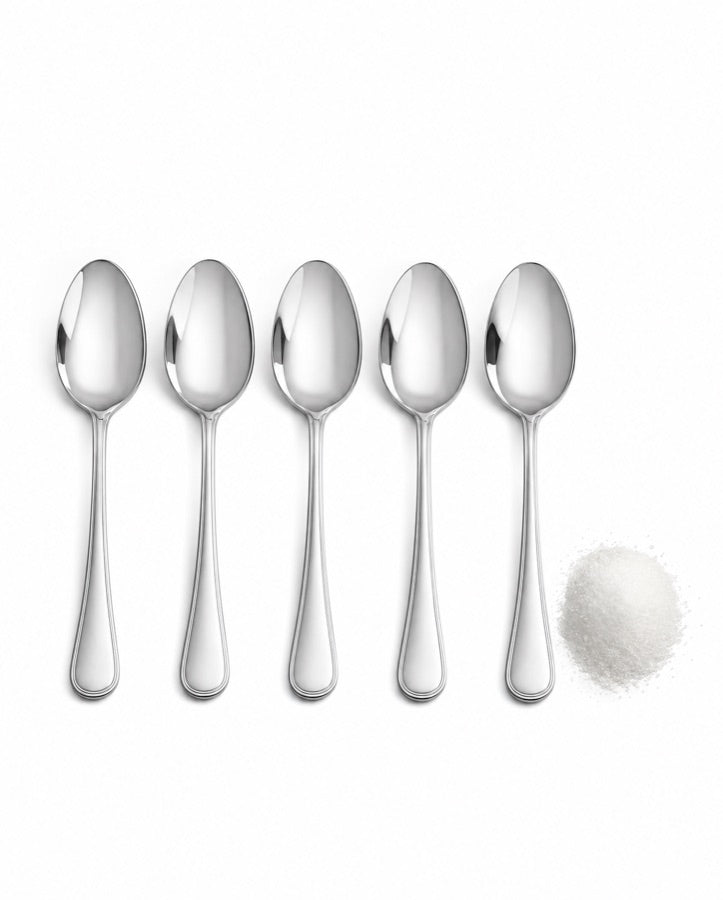
What seven teaspoons actually means
Numbers on a label are hard to feel. Reference points help.
The World Health Organization makes two recommendations on free sugars. The strong one is to keep free sugars under 10% of daily energy, which is about 50g a day for an adult eating 2,000 calories. The second is conditional: dropping below 5%, roughly 25g a day, gives additional benefit.
- One 500ml Pocari Sweat is about 56% of the 50g figure.
- The same bottle is 112% of the 25g figure. You pass that target before the bottle is empty.
- A 350ml bottle is about 40% of the 50g figure, and 78% of the 25g one.
Put next to things you already have a feel for: seven teaspoons is more sugar than two plain Marie biscuits and a teh tarik combined. It is in the same broad range as a can of regular soft drink, though Pocari sits somewhat below most of them. It is a meaningful amount of sugar arriving in a form that does not register as sweet, which is the part worth knowing.
The honest framing. Pocari Sweat is not sneaking sugar past you. Otsuka prints the carbohydrate content on every pack and has done for forty years. The issue is that the drink tastes like mild salty water, so almost nobody mentally files it alongside a soft drink. Your tongue is a poor sugar meter. The label is a good one.
Why the sugar is there
This is the part most articles skip, and skipping it makes Pocari look careless. It is not.
Pocari Sweat was built in 1980 on oral rehydration principles. When your gut absorbs sodium, it moves faster in the presence of glucose. Sodium and glucose are carried across the intestinal wall together, and water follows. This is the mechanism behind every oral rehydration solution the WHO has ever endorsed, and it is why a dehydrated person recovers faster on a lightly sugared salt solution than on plain water.
So the sugar in Pocari Sweat is not there as flavour padding. It is doing two jobs. It assists sodium and water absorption, and it supplies quick carbohydrate to a body that has been working. For someone who has just played ninety minutes of futsal in Klang Valley heat, or who is two days into recovering from a stomach bug, both jobs are useful.
The formula is also genuinely isotonic, meaning its concentration is close to that of body fluid. That is a real design decision with a real rationale, and it is why doctors across Asia have recommended Pocari Sweat for mild dehydration for decades. It earns that reputation.
None of that changes what happens when the same drink becomes a daily habit for somebody sitting in air conditioning.
Is Pocari Sweat healthy?
The useful answer is that health is not a property of the drink. It is a property of the match between the drink and the moment.
Pocari Sweat is the right drink when
- You have been genuinely sweating. A long football match, a hot outdoor job, a full day at a school sports day. The sodium is useful and the carbohydrate is fuel rather than surplus.
- You are recovering from a stomach bug or fever and eating very little. The glucose and sodium combination is the point. For real dehydration, or for a child who is not keeping fluids down, go to a pharmacy for proper oral rehydration salts or see a doctor. Those are formulated for it and cost a few ringgit a sachet.
- A child has been running outdoors for hours. Occasional, in heat, after real activity, it is a reasonable choice.
- You want one cold bottle on a hot day. One bottle is one bottle. Weekly totals matter more than any single drink.
Pocari Sweat is the wrong drink when
- You are in an office all day. You have not lost the sodium, and the 28g of sugar has no work to do.
- You are managing weight, blood sugar or sugar cravings. A daily 500ml bottle adds roughly 840 calories and nearly 200g of sugar across a week.
- You are drinking it because it seems healthier than a soft drink. It has better electrolytes. On sugar it is in a similar range.
- It has become the household fridge default for kids. Occasional is fine. Daily is a habit worth changing, and Malaysia's Ministry of Health has been clear about routine sugary drink intake in children.
- You want everyday hydration support in Malaysian heat. This is the largest group of people drinking it, and it is the worst fit. We wrote about what daily hydration in a tropical climate actually needs in our guide to daily electrolytes in Malaysia.
The electrolytes, in plain numbers
Since electrolytes are the other reason people reach for it, here is what a 500ml bottle delivers: roughly 240mg sodium, 100mg potassium, about 10mg calcium and about 3mg magnesium.
That sodium figure is respectable for a ready to drink bottle and more than most Malaysian isotonics offer. It is also modest against what heavy sweating costs you. Sweat sodium varies a lot between people, but a hard hour in Malaysian humidity commonly runs into several hundred milligrams and can go past a gram. One bottle covers part of that, not all of it. The magnesium is trace only, so Pocari is not a magnesium source.
If you want the hydration without the sugar
The daily use case is where the mismatch sits. If you want electrolytes every day in this climate, the sensible shape is water plus a zero sugar electrolyte mix, and you keep Pocari for the moments it was designed for.
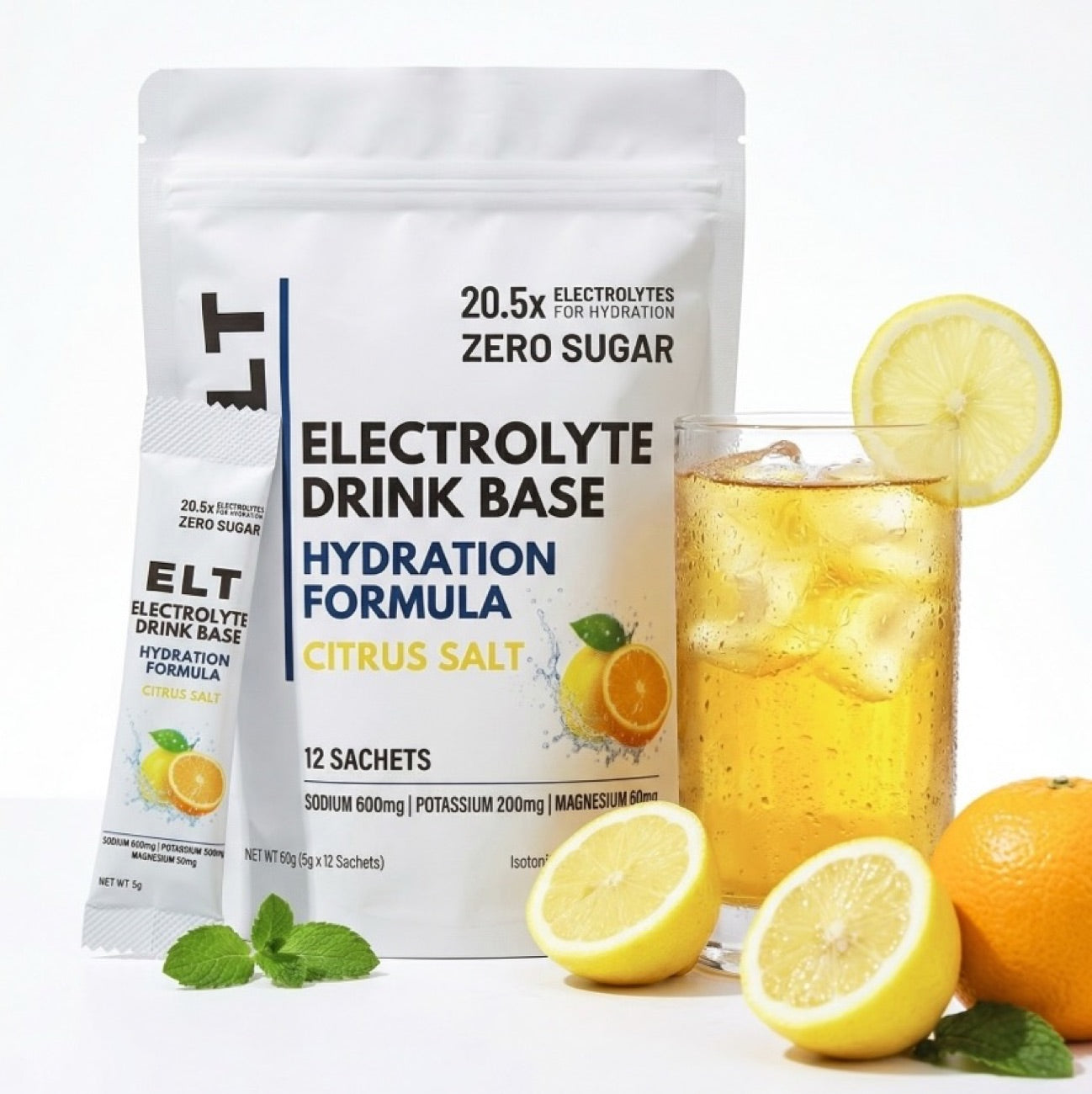
ELT is our take on the daily version. One sachet in water gives 600mg sodium, 200mg potassium and 60mg magnesium, with zero sugar. It is sweetened with stevia, uses halal-certified ingredients, and is manufactured outside Malaysia under a Malaysian Ministry of Health licence. A pouch of 12 sachets is RM 64.80, which works out to RM 5.40 a day.
10% off your first pouch with code WelcometoTeamELT.
We are not the only option, and we say so plainly in our guide to zero sugar electrolytes in Malaysia. Compare a few before you commit to any of them.
Frequently asked questions
How much sugar is in a 500ml bottle of Pocari Sweat?
About 28 grams, which is roughly seven teaspoons. The label declares approximately 5.6g of sugars per 100ml on Southeast Asian bottles. Otsuka's published composition lists 6.2g of carbohydrate per 100ml, which scales to about 31g per 500ml.
How many calories are in Pocari Sweat?
About 120 calories in a 500ml bottle, based on a declared 24 to 25 kcal per 100ml. A 350ml bottle is about 84 calories and a 330ml can is about 79 calories. Ion Water is lower, at roughly 55 to 70 calories per 500ml depending on the market version.
How much sugar is in Pocari Sweat Ion Water?
Roughly 13 to 18 grams per 500ml, or about three to four and a half teaspoons. The Japanese formula declares 2.7g of carbohydrate per 100ml and the Southeast Asian Ion Water Low Calorie version declares closer to 3.6g. It is a real reduction on the regular formula, but it is not a zero sugar drink. Check the bottle you are holding, because the formula differs by market.
Is Pocari Sweat healthy?
It depends entirely on when you drink it. Pocari Sweat is built on sound oral rehydration principles and delivers about 240mg of sodium and 100mg of potassium per 500ml, which makes it a reasonable choice after heavy sweating or during illness recovery. As a daily drink for someone who is not sweating heavily, the 28g of sugar per bottle is the problem. Excellent for what it was designed for, poor as a daily habit.
How much sodium and potassium does Pocari Sweat contain?
A 500ml bottle contains roughly 240mg of sodium and 100mg of potassium, plus trace calcium and magnesium. Otsuka states the salt equivalent as 0.12g per 100ml, which converts to about 47mg of sodium per 100ml.
Is Pocari Sweat better than a soft drink?
On electrolytes, yes, clearly. A 500ml Pocari provides meaningful sodium and potassium where a soft drink provides almost none. On sugar the gap is narrower than most people assume. At about 28g per 500ml, Pocari sits below most regular soft drinks but in the same general range.
Can children drink Pocari Sweat?
Occasionally, yes, and it is widely used across Asia for children during illness recovery. The concern is frequency rather than the drink itself, since 28g of sugar is a large amount in a small body. For a child who is genuinely dehydrated or not keeping fluids down, oral rehydration salts from a pharmacy are the correct choice, and a doctor should be involved if symptoms persist.
Does Pocari Sweat contain artificial sweeteners?
The regular formula does not. Its ingredient list is water, sugar, acidity regulator, sodium chloride, potassium chloride, calcium lactate, magnesium carbonate, flavouring, citrus juice and ascorbic acid, with no preservatives or artificial sweeteners. Lower sugar versions such as Ion Water use sweeteners to hold the taste at reduced sugar levels, so check the specific pack.
Pocari Sweat is a well made product with a clear purpose. Forty years of use across Asia, a formulation grounded in real rehydration science, and a sodium dose that genuinely does something. None of that is in question.
The only thing worth correcting is the assumption that it is a light drink. Seven teaspoons in a 500ml bottle is not light. Keep it for the hot match, the sports day, the recovery week. For the other days, water and a zero sugar electrolyte mix will get you there without the sugar.
Do your best. We've got you.