You know the sequence. Aircon office set near 18°C. Lift down. Thirty seconds across an open car park at 2pm and your shirt sticks to your back. Into the car, aircon on full. Out again at the mall, cold air, dry air. By 5pm you have a dull headache and you blame the meeting.
Nothing in that day counts as exercise. You still lost a meaningful amount of fluid, and you probably did not drink much, because you never felt like you were working hard. This is a guide to hydration in KL as the city actually is. Mostly it is about plain water, because water is the honest answer for most of a normal day here.
What the humidity number actually means for your body
Kuala Lumpur runs at an average high of roughly 31-32°C and average relative humidity around 80% year round. Those numbers barely move between January and December, so there is no season where your body gets a break. Most people read the temperature and ignore the humidity. The humidity matters more.
Sweat does not cool you. Evaporating sweat cools you. When a droplet changes from liquid to vapour on your skin, it carries heat away. That phase change is the cooling. Sweat that runs down your back and soaks into your shirt has done nothing for your core temperature.
Whether sweat evaporates depends on how much water vapour the surrounding air can still absorb. At 30% humidity the air is thirsty, and sweat lifts off almost as fast as you produce it. At 80% humidity the air is already close to saturated, so evaporation slows to a crawl and the sweat gathers into drops and falls off you.
You paid for that sweat. You lost the water and the salt. You got almost none of the cooling in return.
Your body responds the only way it knows how, which is to sweat harder. So a humid day costs you more fluid than a dry day at the same temperature, while cooling you less. That is why 32°C in KL is genuinely harder work than 32°C somewhere dry. It is not a figure of speech, and it is not you being soft.
| Condition | What happens to sweat | What it costs you |
|---|---|---|
| 32°C, 30% humidity | Evaporates quickly off the skin | Moderate fluid loss, effective cooling |
| 32°C, 80% humidity (typical KL afternoon) | Beads, runs, drips off | Higher fluid loss, much weaker cooling |
The aircon cycle nobody accounts for
An air conditioner cools air by condensing moisture out of it. Dehumidifying is not a side effect, it is half the job, so the air in your office, car and mall is noticeably drier than the air outside.
Dry air pulls water out of you every time you breathe. Eight hours in a cold office, a commute each way with the vents on, then seven hours asleep under a bedroom unit. That is most of your day spent breathing air that is quietly taking water off you. It is a slow leak rather than a flood, and it never gets your attention, because you are not hot and nothing tells you to drink.
The cycle is the problem. Outdoors you lose fluid fast and notice it. Indoors you lose fluid slowly and never notice it. Both run all day.
Why you feel thirstier in a mall than outside
Walk from the car park into a mall and the sweat that was refusing to evaporate outside hits cold dry air and lifts off almost instantly. You cool down fast and feel better within a minute. The comfort is real and slightly misleading: you already lost that fluid outside, you just did not feel the cost until now.
Meanwhile the dry air works on your airways. Mouth and throat dry out first, and that dryness is most of what you register as thirst. Add an hour of walking with no bottle in hand and the thirst is not a mystery.
The commute nobody counts as heat exposure
Thirty minutes on a motorbike. Riders sit under a helmet and often a jacket, in traffic, with engine heat underneath and no shade. Moving air helps a little, and stationary traffic removes even that. It is one of the harder heat exposures in the city, twice a day, five days a week. Drink before you get on, not just after you arrive.
The LRT and MRT platform. Underground stations are cooled. Many elevated platforms are not. Standing on an open platform at 6pm in still air, in work clothes, then packing into a full carriage is a heat load even when the carriage is cold.
The car park dash. Two or three minutes of full sun across open tarmac, six or eight times a day, adds up to more than people think.
Covered walkways. Shade removes the load from direct sun, which is real. It does not change the humidity, so shade does not mean you have stopped losing fluid.
If you work outdoors in this city
Construction workers, delivery riders, security guards, landscapers and road crews do all of the above for eight to twelve hours instead of three minutes. The guidance for sustained outdoor work is consistent: drink small amounts often rather than large amounts occasionally, rest in shade before you feel you need it, and do not use thirst as your timer. Thirst lags behind fluid loss, so by the time it arrives you are already behind.
A full day of heavy sweating is where sodium losses stop being theoretical, because you lose salt in every litre of sweat. That mechanism is covered in our guide to daily electrolytes in a tropical climate and in the piece on whether electrolytes help muscle cramps.
Heat exhaustion and heat stroke: know the difference
Heat exhaustion looks like heavy sweating, skin that is pale, cool and clammy, a fast weak pulse, dizziness, headache, nausea, muscle cramps, and feeling weak or faint. Move the person into shade or aircon, loosen tight clothing, cool them with wet cloths and airflow, and give small sips of water. If they are vomiting, if symptoms worsen, or if they do not improve within about an hour, get medical help.
Heat stroke is a medical emergency. Call 999. The warning signs are a very high body temperature (around 40°C or above), confusion, slurred speech, agitation or strange behaviour, seizures, or loss of consciousness. The skin may be hot and dry because sweating has stopped, though in humid conditions someone can be soaked in sweat and still be in heat stroke. Do not wait to see if it passes. While waiting for help, move them into shade or aircon and cool them aggressively with water on the skin, wet cloths and a fan. Do not give fluids to anyone confused, drowsy or unconscious.
Confusion, a stop in sweating, or a very high body temperature turn this from a bad afternoon into an emergency.
Coffee and teh tarik, honestly
The common belief is that coffee dehydrates you and should not count toward your fluid intake. The research does not support that at normal intakes.
A well-known crossover study found no evidence of dehydration in habitual coffee drinkers at three to four cups a day compared with the same volume of water. Total body water did not differ. Caffeine is a mild diuretic, but regular drinkers build tolerance to that effect, and the water in the cup more than covers the small extra loss. So your kopi counts. Your teh tarik at the mamak counts.
Two caveats. Very high caffeine intakes, well beyond a few cups, do increase fluid and electrolyte excretion. And the sugar is a separate question from the hydration: three sweet drinks a day is a sugar decision, not a hydration one. If sweetened isotonic drinks are your default, our comparison of 100Plus and Pocari Sweat sugar is worth a look.
A realistic hydration rhythm for a KL workday
On waking: 300-500ml of water before coffee. You have spent seven hours breathing dry aircon air.
Morning: Keep a 1L bottle in sight. A visible bottle does more work than any reminder app. Finish it by lunch.
Before you go outside: 200-300ml before the car park, the ride or the walk. Pre-loading is easier on your stomach than catching up.
Afternoon: Refill. The 3-4pm slump is often partly a fluid deficit, and the cheapest thing to rule out.
Commute home: Water within reach if you drive or ride.
Evening: Normal drinking with dinner. Ease off after about 8pm or you will be awake at 3am.
Check: Pale straw-coloured urine through the day means you are roughly where you should be. A better signal than counting glasses.
Haze season
Roughly August to October, KL can sit under haze for days. In September 2026, dozens of stations across Malaysia logged Air Pollutant Index readings in the unhealthy band (101-200).
Haze does not dehydrate you directly. It changes your behaviour. You stay indoors more, which means more hours in dry aircon air, and people often drink less on haze days because they are not hot.
The real protections are the ones you already know: check the API before outdoor activity, move hard training indoors when readings go unhealthy, wear a proper filtering mask outside if you are sensitive, and follow your doctor's plan if you have asthma. Hydration is a comfort measure here. Do not let anyone sell it as more than that.
What to drink, by situation
Normal office day: Water. Coffee and tea count toward the total.
Errands, mall, school run: Water, and more than you think. Carry a bottle.
Thirty minutes or more on a motorbike: Water before and after. On a long riding day, add salt at your next meal.
A full day of outdoor work: Water steadily, plus salt with meals. Sweating through your clothes for hours can leave you short on sodium even when you drink enough water.
Training or sport in the heat: Water during, plus something with sodium if the session runs long or you are a salty sweater (white marks on a dark shirt is the tell).
Illness with vomiting or diarrhoea: Oral rehydration salts from any pharmacy. Cheap, and built for exactly this.
Haze days indoors: Water. Nothing special needed.
The short version
Humidity is the part of KL heat most people misread. At around 80% your sweat runs off instead of evaporating, so you pay the full fluid and salt cost and get a fraction of the cooling. Aircon dries you out from the other direction, all day. Neither feels like a reason to drink, which is why they add up.
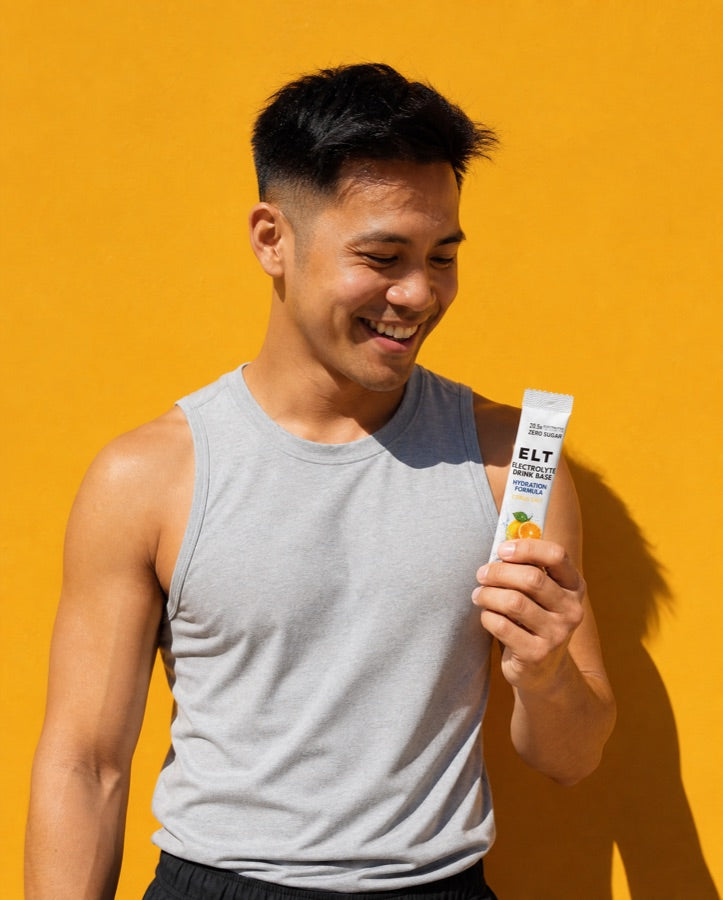
For the days where water alone leaves you short, a full day outdoors, a long ride, sport in the afternoon heat, ELT is a zero-sugar electrolyte sachet you mix into water. 600mg sodium, 200mg potassium, 60mg magnesium. Halal-certified ingredients. RM 64.80 for a pouch of 12, so RM 5.40 a sachet. Made outside Malaysia under a Malaysian Ministry of Health licence, formulated for people living in this climate. It is not a replacement for water, and most KL days do not need it. To compare options, our zero-sugar electrolyte buyer's guide covers the category.
10% off your first pouch with code WelcometoTeamELT.
Frequently asked questions
How much water should I drink in Malaysia?
A reasonable floor is around 30-40ml per kilogram of body weight, so roughly 2.1-2.8L for a 70kg adult, with more for time outdoors or training. Rather than counting, use urine colour: pale straw means you are about right, dark means drink more. Coffee, tea and food count.
Why does 32°C in KL feel worse than 32°C somewhere dry?
Because sweat only cools you when it evaporates. At around 80% humidity the air is close to saturated and can absorb very little extra moisture, so your sweat beads and runs off. You lose the fluid and the salt without the cooling, and your body sweats harder to compensate, costing you more fluid again.
Does air conditioning dehydrate you?
Mildly and continuously, yes. Air conditioners cool by removing moisture from the air, so indoor air is drier. You lose water through your lungs with every breath, and dry air increases that loss. A workday plus a night of sleep in aircon adds up, and it never triggers thirst the way heat does.
Does coffee or teh tarik count toward my fluid intake?
Yes. Research on habitual coffee drinkers at three to four cups a day found no evidence of dehydration compared with the same volume of water. Caffeine is a mild diuretic and regular drinkers build tolerance to it, so the water in the drink more than covers the loss. The sugar in sweetened drinks is a separate question from hydration.
When is heat illness an emergency?
Heat exhaustion (heavy sweating, cool clammy skin, dizziness, nausea, weakness) needs cooling, rest and fluids, plus medical attention if it does not improve within about an hour or if there is vomiting. Heat stroke is an emergency: call 999 if someone has a very high body temperature, is confused, has stopped sweating, has a seizure, or loses consciousness. Cool them aggressively while waiting for help.
Do I need electrolytes just to get through a normal KL day?
For most people on a normal indoor day, no. Water plus a normal diet covers it, and Malaysian food provides plenty of sodium. The case gets stronger with sustained heavy sweating: outdoor work, long rides, hard afternoon training, or illness. Our tropical climate electrolyte guide works through who benefits.
Does hydration help during haze season?
It helps with comfort, not with the air. Staying hydrated keeps your throat less irritated, which is worth something when the API is high. It does not filter particles and it does not treat any respiratory condition. Check the API before outdoor activity, train indoors on unhealthy days, and follow your doctor's guidance if you have asthma.
Hydration in KL is less about heroic water targets and more about noticing the losses you have been ignoring. The three minutes in the car park. The ride home. The eight hours of dry office air. None of them feel like anything at the time, and together they are most of your daily deficit.
Start with the bottle you can see and the glass before you walk outside.
Stay ready. Keep going. We've got you.